Aspects of yourself— like ways of thinking — that you’re unaware of.
For example, you may have unconscious reasons for doing certain things or thinking in certain ways.
Furthermore, some of your undesirable behaviors, habits, and emotions may be caused or influenced by unconscious ways of thinking.
With the right self-analysis tools, you can become conscious/aware of these unconscious thought patterns and change them.
We provide solutions and insights to help you uncover and dismantle unconscious thoughts and beliefs.
Note: Being conscious of something means we are aware of it (3).
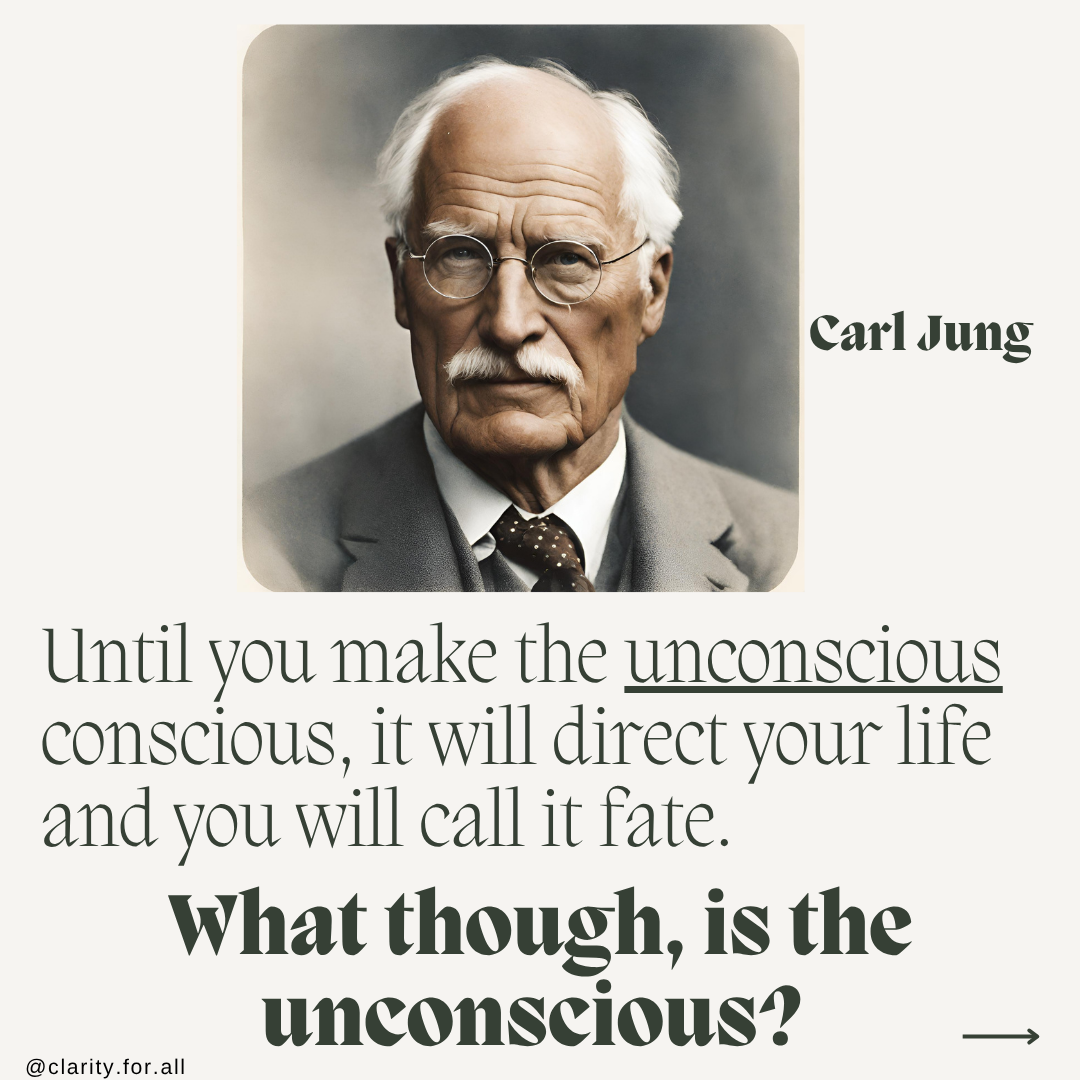
Until you make the unconscious conscious, it will direct your life and you will call it fate. — Carl Jung
—-
(1) Dijksterhuis, A. (2024). The unconscious. In R. Biswas-Diener & E. Diener (Eds), Noba textbook series: Psychology. Champaign, IL: DEF publishers. Retrieved from http://noba.to/46hrvmab
(2) Dasgupta, N. (2013). Implicit Attitudes and Beliefs Adapt to Situations: A Decade of Research on the Malleability of Implicit Prejudice, Stereotypes, and the Self-Concept. Advances in Experimental Social Psychology, 47, 233–279.
(3) https://dictionary.cambridge.org/us/dictionary/english/conscious
(4) Westen, Drew (1999). “The Scientific Status of Unconscious Processes: Is Freud Really Dead?”. Journal of the American Psychoanalytic Association. 47 (4): 1061–1106. doi:10.1177/000306519904700404. ISSN 0003–0651. PMID 10650551. S2CID 207080.
(5)Kahneman, Daniel (2013). Thinking, Fast and Slow. Farrar, Straus and Giroux. ISBN 978–0374533557.
(6)https://www.psychologytoday.com/us/basics/unconscious#how-therapists-work-with-the-unconscious-mind